Do heat pumps actually make sense in a cold climate?
The short version
- Heat pumps work in cold climates. Federal field studies measured them running through real winters in occupied homes. The question was never whether they produce heat below freezing; it is what that heat costs. [PNNL-37127 (2025)]
- Against natural gas in cold states, running cost is usually worse. A heat pump needs a COP between 3.4 and 5.4 just to break even, which no unit on the market holds through a northern winter.
- Against oil and propane it is usually better, and by a wide margin. The same states need only 1.1 to 2.8, which a good cold climate unit holds well into the teens.
- Installation quality matters more than climate. Across 21 households the spread between best and worst is a factor of 12 in near identical weather.
The honest answer is that the cold is not the problem. The fuel you are replacing is.

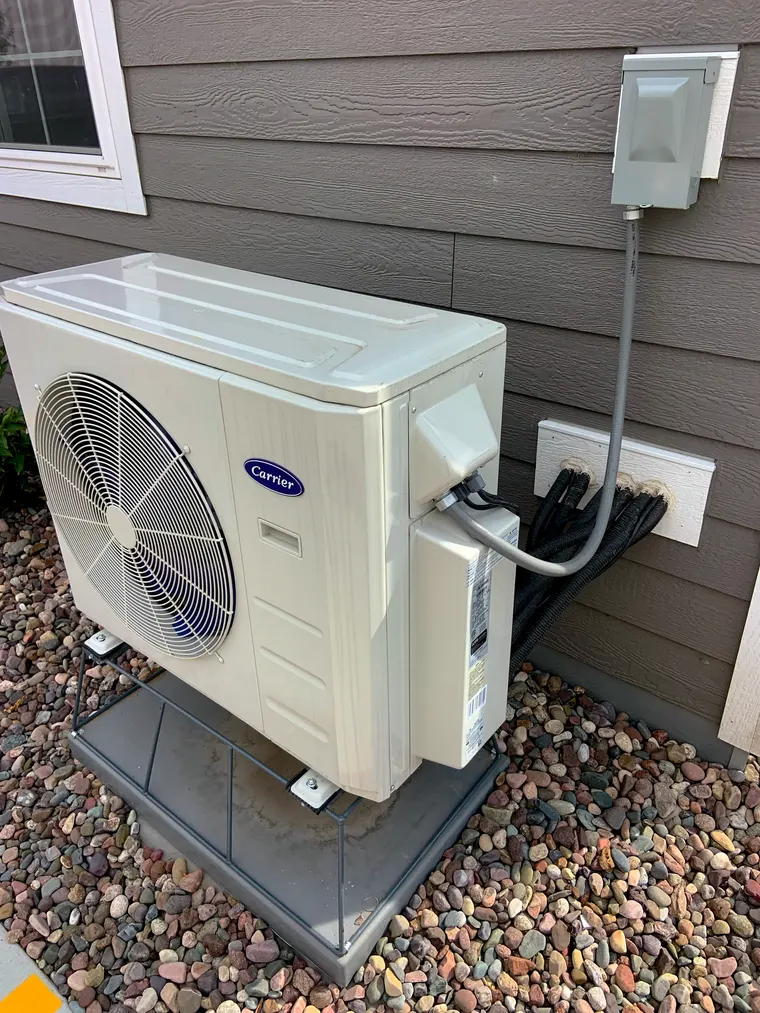
The cold is not the problem
The objection to heat pumps in cold climates is usually framed as physics: it gets too cold, there is no heat in the air, the machine stops working. The physics part is not in dispute and it is also not the issue. There is heat in air well below zero, and cold climate units are specified and tested to produce useful output at 5F and below. [DOE CCHP Challenge specification]
Two federal field studies settled the "does it work" question by measuring real installations through real winters rather than in a laboratory. PNNL instrumented 22 cold climate heat pumps and measured a median COP of 1.9 in the 0 to 5F band. NREL found something more interesting across 12 ordinary installations: at two sites the resistance backup strips consumed more energy than the compressor did. [PNNL-37127 (2025)] [NREL/TP-5500-84745 (2023)]
Both results are true, and the gap between them is the actual finding. The full read of both studies is here. A cold climate heat pump that is correctly sized, correctly commissioned and not fighting its own backup heat performs roughly as advertised. One that is not can consume more electricity than the resistance heat it replaced.
What actually decides it: the fuel you are replacing
Here is the number a heat pump has to beat in each cold state for the incumbent fuel to stop being cheaper, at that state's own December 2025 to February 2026 EIA prices.
| State | Annual HDD | Electricity $/kWh | vs gas | vs oil | vs propane |
|---|---|---|---|---|---|
| Iowa | 6,274 | 0.127 | 3.52 | 1.30 | 1.54 |
| Minnesota | 6,274 | 0.151 | not published | 1.54 | 1.82 |
| North Dakota | 6,274 | 0.112 | 3.71 | 1.14 | 1.35 |
| South Dakota | 6,274 | 0.131 | 3.85 | 1.34 | 1.58 |
| Connecticut | 6,022 | 0.281 | 4.72 | 2.50 | 2.01 |
| Massachusetts | 6,022 | 0.308 | 3.44 | 2.74 | 2.20 |
| Maine | 6,022 | 0.311 | not published | 2.77 | 2.22 |
| New Hampshire | 6,022 | 0.264 | 4.00 | 2.35 | 1.88 |
| Rhode Island | 6,022 | 0.302 | 4.18 | 2.69 | 2.16 |
| Vermont | 6,022 | 0.233 | 4.14 | 2.07 | 1.66 |
| Michigan | 5,897 | 0.197 | 5.43 | 2.01 | 2.38 |
| Wisconsin | 5,897 | 0.183 | 4.29 | 1.86 | 2.21 |
| New York | 5,399 | 0.286 | 5.11 | 2.46 | 2.16 |
| Montana | 4,832 | 0.130 | 4.31 | 1.15 | 1.49 |
Sorted by heating degree days, coldest first. Degree days are census division normals rather than state figures. Maine and Minnesota carry no gas column because EIA has not published a complete December to February residential gas season for them.
Read down the gas column and then the propane column. The climate is identical; the target moves by a factor of two. A household in the same town with the same equipment gets a completely different answer depending on what is in the tank outside.
Why two identical houses get bills a factor apart
15 of the 21 households in this site's dataset are in the cold states above. Normalised to watt hours per square foot per heating degree day, so that size and weather are already accounted for, they still do not cluster.
| Household | Floor area | Wh per sq ft per HDD | What was found, and by whom |
|---|---|---|---|
| Upstate New York Ducted Mitsubishi, all electric |
3,800 | 0.53 | No fault identified. |
| Rhode Island heat pump, new build |
2,000 | 0.57 | No fault identified. |
| Southern New Hampshire 18k and 12k heat pumps |
1,500 | 0.68 | No fault identified. |
| Massachusetts, Boston area Two Bosch IDS Premium, 3.5 ton lower and 2.5 ton upper, plus a basement mini-split |
2,750 | 0.75 | No fault identified. |
| Berkshires, Massachusetts Fujitsu Airstage mini-splits |
2,200 | 0.78 | No fault identified. |
| Connecticut heat pump, zoned |
2,200 | 0.79 | No fault identified. |
| Northwest Iowa Goodman gas furnace plus three Tosot mini-splits, self-installed |
1,100 | 0.80 | No fault identified. |
| Upstate New York A single 18,000 BTU/h mini split |
1,350 | 0.84 | No fault identified. |
| Southern Maine Heat pumps plus a heat pump water heater, everything in the house electric |
2,400 | 0.92 | No fault identified. |
| Massachusetts 5-ton heat pump, gas for most other appliances |
2,100 | 1.09 | An electric vehicle charges on the same meter, so an unknown part of this is not heating at all. The one entry here whose cause is measurement rather than the house. Identified by the householder. |
| Midcoast Maine, Lincoln County Mitsubishi hyper heating ductless, 15,000 and 9,000 BTU/h, covering about 1,200 of the 1,600 sq ft |
1,600 | 1.34 | Electric baseboards still running in one office and holding the basement at 55F, a resistance water heater, and a non-heating base load of 15 to 20 kWh a day carried inside this figure. Identified by the householder. |
| Connecticut, fully electric Heat pump running alongside electric baseboards |
2,400 | 1.45 | A heat pump and electric baseboards heating the same house at the same time. Whatever share the baseboards carry arrives at a coefficient of performance of exactly 1.0. Identified by the householder. |
| Southern New Hampshire Samsung R32 ducted, two zones, $24,000 installed |
1,400 | 1.89 | Implied seasonal COP of 1.24 to 1.42 against 2.5 to 3.2 for a working system. Most likely a compressor lockout left at its factory default. Inferred by this site from their posted figures, so it deserves less weight. |
| Queens, New York City Three GREE ductless mini-splits, one per room, installed by the landlord |
1,150 | 2.24 | Three ductless units running at 96% of flat out for a whole month, in a rental where the tenant chose none of it and can change none of it. Inferred by this site from their posted figures, so it deserves less weight. |
| Coastal Maine, near Bar Harbor Two Mitsubishi ductless heat pumps rated 12,000 and 15,000 BTU/h, plus a new heat pump water heater in the basement |
1,600 | 2.58 | Switched off every day while the household is out, on a pair of units whose maximum possible draw cannot account for the bill. Probable live electric baseboards behind it. Inferred by this site from their posted figures, so it deserves less weight. |
Households with no identified fault sit between 0.53 and 0.92. The ones above that band each had a specific and mostly fixable cause. The weather did not vary by a factor of 12; the installations did.
This is the part of the cold climate question that gets least attention and deserves most. Whether a heat pump is a good idea in Vermont is largely a question about the installer, not about Vermont. The full dataset, the band, and every identified cause is here.
What to do with this if you live somewhere cold
- Find out what you actually pay for electricity and for your current fuel, from a bill rather than an average. Your state page has the state mean, but utilities inside one state differ enormously.
- Read the target COP off the table above for your fuel, then get the COP table for any unit you are considering at 47F, 17F and 5F. [AHRI 210/240-2023] If it does not clear the target at the temperatures where you spend most of your heating hours, the running cost case is weak.
- If you heat with gas, look at dual fuel rather than treating it as a binary. Keeping the furnace for the coldest hours and running the heat pump for the many mild ones captures most of the benefit. The crossover setting is computable and usually set wrong.
- Insist on a load calculation. Oversizing is the most common expensive error, and in a cold climate it also means more short cycling and more backup heat. [ACCA Manual J]
- Ask what the auxiliary heat lockout is set to. A small share of heat from resistance strips costs a disproportionate share of seasonal efficiency. The arithmetic is harsher than intuition suggests.
Who this page is for, and who it is not
It is for you if you live somewhere with a real winter and want to know whether the running cost case survives the cold, with figures for your own state rather than a national average.
It is not for you if you are in a mild climate. The cold weather COP question barely bites there and the fuel price comparison is simpler; start with the fuel comparisons.
It is also not for you if your question is about capacity rather than cost, meaning whether the machine can keep the house warm at all. That is a sizing question for a load calculation, not a price question.
Common questions
Do heat pumps work below freezing?
Yes, and this is measured rather than claimed. PNNL instrumented 22 cold climate heat pumps in occupied homes and recorded a median COP of 1.9 in the 0 to 5F band, meaning nearly twice as much heat delivered as electricity consumed at those temperatures. Whether that is cheap enough depends entirely on what fuel it is competing with.
Are heat pumps cheaper than oil heat in cold climates?
Usually yes, and by a wide margin. Across the cold states in this dataset a heat pump only needs a COP between 1.1 and 2.8 to match an 83% efficient oil boiler, which a good cold climate unit holds through most of a heating season.
Are heat pumps cheaper than natural gas in cold climates?
Usually no, on running cost. The breakeven COP against a 95% AFUE gas furnace in these states runs from 3.4 to 5.4, and no unit holds that through a northern winter. Dual fuel is the usual answer where gas is already connected.
Why do some cold climate heat pumps cost so much more to run than others?
Because backup heat dominates. Across the households in this dataset the spread between best and worst is a factor of 12 in near identical weather, and every household above the normal band had an identified cause: a lockout at a factory default, a thermostat energising resistance strips unnecessarily, or a system sized for a load it never sees.
Does a cold climate model actually make a difference?
Yes, but the label matters less than the data sheet. What you want is the capacity and COP table at 17F and 5F, not the badge. Two units both marketed as cold climate can behave very differently at 5F, and the difference is exactly where a northern heating season spends its expensive hours.
How this was checked
Breakeven COP figures are computed from EIA state level residential prices for December 2025 to February 2026 using the same heating values and default efficiencies as the rest of this site. The arithmetic is one line, stated on the crossover page, and both inputs and outputs are in the published dataset.
The field performance figures come from two federal studies of instrumented occupied homes rather than laboratory testing. [PNNL-37127 (2025)] [NREL/TP-5500-84745 (2023)] The household spread comes from 21 homes whose occupants published their own consumption, normalised per square foot per heating degree day, with nothing estimated on their behalf.
What this page does not cover
Capacity and sizing. Whether a given unit can keep a given house warm at design temperature is a load calculation question, not a price question.
Equipment and installation cost, which is frequently higher in cold climates because the units that perform well down low cost more.
Defrost behaviour and comfort in very cold, damp conditions.
Grid capacity and winter peaking. A real policy question at scale, and outside what a household running cost model addresses.
References
- Mendon, V., Keene, K., Rosenberg, S., Rotondo, J. A., Nwe, K., Young, J., Wind, W., and Goetzler, B. (2025). Performance Results from DOE Cold Climate Heat Pump Challenge Field Validation. PNNL-37127. Pacific Northwest National Laboratory, prepared for the U.S. Department of Energy under Contract DE-AC05-76RL01830. January 2025.
- Winkler, J. and Ramaraj, S. (2023). Field Validation of Air-Source Heat Pumps for Cold Climates. NREL/TP-5500-84745. National Renewable Energy Laboratory. May 2023.
- U.S. Department of Energy, Building Technologies Office (2021). Residential Cold Climate Heat Pump Technology Challenge Specification.
- U.S. Environmental Protection Agency. ENERGY STAR Program Requirements for Central Air Conditioners and Heat Pumps, cold climate heat pump criteria requiring a COP above 1.75 at 5°F.
- U.S. Energy Information Administration. Electricity Data Browser, retail sales and average price by state and sector, monthly. Series accessed through the EIA Open Data API v2.
- U.S. Energy Information Administration (2025). Electricity use is becoming more common for residential heating. Today in Energy, citing U.S. Census Bureau American Community Survey and the Residential Energy Consumption Survey.
- Air-Conditioning, Heating, and Refrigeration Institute. AHRI Standard 210/240-2023: Performance Rating of Unitary Air-Conditioning and Air-Source Heat Pump Equipment. This standard defines the M1 test procedure and the HSPF2 metric.
- Air Conditioning Contractors of America. Manual J: Residential Load Calculation, the standard method for sizing residential heating and cooling equipment.
Related reading
Run it on your own winter
Your state, your prices, and your own backup heat assumption.
Open the calculator