Three ways a heat pump ends up not running, and how to test for it on your own bill
The short version
- Three documented causes, one signature. A thermostat compressor lockout left at a factory default around 35F. A breaker switched off because the panel labels it air conditioning. An incorrectly sized fuse.
- Nothing obvious tells you. The house holds temperature, the outdoor unit looks normal, and the only symptom is the bill.
- You can test for it from twelve months of kWh readings and a shoulder month. If your implied seasonal COP comes out below about 1.6, something is wrong.
- Worked example below: a New Hampshire homeowner whose implied COP came out at 1.36, which means roughly 59% of their heat was coming from resistance strips in a system that cost $24,000.
- A second household in Ohio ran two months at 3,500 kWh before a technician found the breaker off and a wrong sized fuse. Consumption fell 27% after both were fixed, at the price of a fuse.
A thermostat locked out at a factory default. A breaker switched off because it was labelled air conditioning. A fuse of the wrong size. Three unrelated causes, one signature: the compressor stops and electric resistance strips heat your house at three times the price. The equipment looks fine, the house stays warm, and only the bill knows.

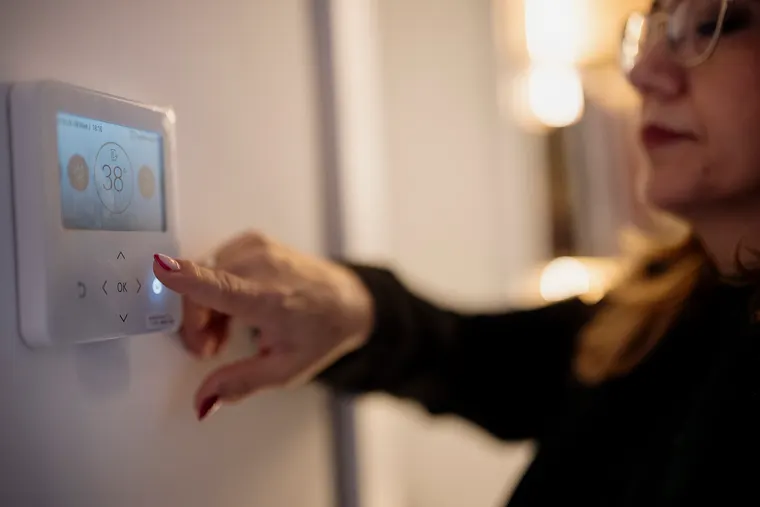
What the lockout is
Most heat pump thermostats have a setting variously called compressor lockout, outdoor lockout, or balance point setting. It stops the compressor running below a chosen outdoor temperature, on the assumption that below that point the heat pump is doing more harm than good.
That assumption was reasonable in 1995. A single stage heat pump of that era genuinely lost most of its advantage in the twenties, and locking it out avoided running an expensive machine badly. A modern cold climate unit holds a useful coefficient of performance well below zero, so the same setting now switches off the efficient machine exactly when you need it and hands the entire load to resistance heat.
There is a related setting, sometimes called droop or differential, which brings on the strips when the room is more than a set number of degrees below setpoint. A default of 2F means that raising the thermostat by three degrees fires the resistance heat immediately, which is why a night setback can cost more than it saves in a heat pump house.
Three ways this happens, all with the same signature
I started this page believing thermostat lockout was the explanation. Reading further, it is one of at least three, and they are worth separating because the fix for each is different and two of them cost nothing.
1. Compressor lockout left at a default
Covered in detail in the section above. The thermostat is told not to run the compressor below a set outdoor temperature, commonly around 35F, and the strips take the load below that. Homeowners repeatedly report thermostats arriving configured this way and installers leaving it. One describes changing the setting from 35F to minus 10F and the system working properly from that point.
2. The breaker labelled air conditioning
An Ohio homeowner ran two consecutive months at 3,500 kWh, roughly $700 each, in a new 1,863 square foot all electric house. [r/hvacadvice, Ohio homeowner] In their own words:
At some point the AC was turned off at the breaker. We didn't know about heat pumps.
On a heat pump the outdoor unit is the same machine in summer and winter. Switching off the breaker labelled air conditioning switches off the heat pump, and the system quietly falls back to resistance heat without complaining, because that is what backup heat is for.
3. A wrong sized fuse
The same Ohio household later posted an update:
HVAC company came out and replaced a fuse that was the wrong size. Seems to have made a big difference.
This is the one you cannot find yourself, and it is a reminder that not every case on this page is a settings problem. A component that limits or interrupts the compressor produces the same bill as a thermostat that refuses to run it.
Why you would not notice
Every symptom of this failure looks like the system working.
- The house stays warm. Resistance strips are perfectly capable of heating a house. They are just expensive.
- The outdoor unit still runs above the lockout temperature, and in defrost, so it does not look dead.
- No fault is logged. The system is doing exactly what it was configured to do.
- Many thermostats do not clearly report auxiliary runtime, and some show an "AUX" indicator only briefly or not at all.
The bill is the only signal, and the bill arrives a month late, mixed in with everything else in the house, during a cold snap that gives you a reason to dismiss it.
A worked diagnosis from a real bill
A homeowner in southern New Hampshire posted their situation publicly: a 1,400 square foot ranch with R-60 in the attic, a Samsung R32 ducted, two zones, $24,000 installed installed two months earlier, and bills near $1,000 a month. Their previous system was 1980s electric resistance heat. [r/heatpumps, New Hampshire homeowner]
Their utility bill listed twelve months of kWh, which is enough to diagnose this without visiting the house.
| Reading | kWh | What it is |
|---|---|---|
| October | 988 | Shoulder month, no heating or cooling. This is the rest of the house. |
| February, old resistance system | 4,634 | Total |
| February, new heat pump | 3,938 | Total |
Subtract the baseline from each February and you have the heating portion: 3,646 kWh on resistance heat, 2,950 kWh on the heat pump. A reduction of 19%.
Divide the heat needed by the electricity the new system used, and you get the seasonal COP the new system actually delivered. Several commenters noted this winter was colder, so here it is across a range of winter severity:
| Winter colder by | Implied seasonal COP | Share of heat from resistance strips |
|---|---|---|
| 0% | 1.24 | 70% |
| 5% | 1.30 | 64% |
| 10% | 1.36 | 59% |
| 15% | 1.42 | 54% |
Resistance share assumes the compressor itself manages a COP of 2.8 when it does run.
A working cold climate heat pump delivers a seasonal COP of 2.5 to 3.2. PNNL measured a field median of 1.6 to 2.7 below 30F across 22 instrumented homes. [PNNL-37127 (2025)] This system is returning somewhere between 1.24 and 1.42.
A second worked case, with a before and after
The New Hampshire diagnosis above is calculable because that household previously heated with electric resistance. Most people do not have that. The Ohio case is useful for the opposite reason: there is no clean before, but there is a documented intervention with readings on both sides of it.
| Ohio, 1,863 sq ft, all electric | kWh | Normalised |
|---|---|---|
| Month 1, breaker off | 3,500 | 1.52 |
| Month 2, breaker off | 3,500 | 1.52 |
| After breaker on and fuse replaced | 2,565 | 1.11 |
Normalised as watt hours per square foot per heating degree day, the metric used across the household dataset, where most houses sit between 0.53 and 0.80.
A 27% reduction from switching a breaker back on and replacing a fuse. Two consecutive identical months at 3,500 kWh is itself a diagnostic: a heat pump responding to weather does not produce the same number twice, and resistance strips holding a setpoint very nearly do.
Run the same test on your own bill
You need three numbers from twelve months of readings, which most utilities show on the bill or in an online account.
If you rent and cannot change any of the settings this page describes, the renter version of this diagnosis covers what evidence actually gets a landlord to act. This only works if your previous system was electric resistance, because that is the case where last year's meter reading is also a measurement of the heat your house needed. If you switched from gas, oil or propane there is no equivalent shortcut, and the auxiliary heat page covers what to check instead.
What to check, in order
- Find the compressor lockout setting. It lives in the installer or advanced menu, not the normal one, and the manual will tell you how to reach it. If it is set anywhere near 35F and you own a modern cold climate unit, that is very likely your answer.
- Find out what your equipment is actually rated to. Manufacturers publish capacity and COP at 47F, 17F and 5F. Many current units hold a useful COP well below zero. Set the lockout below the point where your unit stops being better than resistance heat, not at a number inherited from 1995.
- Check the droop or differential setting. A default of 2F fires the strips on any meaningful temperature change. Widening it to 4 to 6F stops the system reaching for resistance heat every time you adjust the thermostat.
- Stop using a night setback while you are testing. Heat pumps hold a temperature more cheaply than they recover one.
- Check the breaker for the outdoor unit is on. On a heat pump it is the same machine that gives you air conditioning, and a panel labelled accordingly has caught at least one household for two full months.
- Confirm what you actually bought. More than one homeowner has posted a spec sheet during a discussion like this and been told by strangers that the document describes a cooling only unit.
Why I think this explains the field data
This site has been carrying two findings that sat next to each other without connecting.
NREL instrumented 12 heat pumps in occupied homes and found auxiliary heat energy exceeding 35% of compressor energy at 5 sites, and exceeding compressor energy entirely at 2. [NREL/TP-5500-84745 (2023)] PNNL instrumented 22 units that had all been sized by Manual J load calculation and found auxiliary heat to be a small fraction of delivered heat. [PNNL-37127 (2025)]
I had explained that gap as equipment quality and sizing, which is part of it. What I did not have was a mechanism that could take a functioning machine in a reasonable house and produce a result that bad.
Compressor lockout at a default setting is that mechanism, and it is consistent with the evidence. It is invisible without a settings audit or a circuit monitor. It produces exactly the signature NREL measured, resistance heat outconsuming the compressor. And it is a commissioning failure rather than an equipment failure, which fits PNNL's better outcome on a sample where somebody had done the load calculation and presumably the rest of the setup with it.
Common questions
Why would a thermostat stop the heat pump running below 35F?
Because for older single stage equipment that was reasonable advice: below the twenties those machines lost most of their advantage over resistance heat. Modern cold climate units hold a useful coefficient of performance far below that, so a setting inherited from older practice now switches off the efficient machine for the whole cold half of winter.
How do I know if my heat pump is running or just the backup?
The cleanest test is a circuit level energy monitor on the air handler. Without one, compare a winter month against a shoulder month to isolate heating consumption, and if your previous system was electric resistance you can calculate the implied seasonal COP directly using the calculator on this page. Below about 1.6 means something is wrong.
My heat pump breaker is labelled air conditioning. Does that matter?
It matters a great deal. On a heat pump the outdoor unit is the same machine in both seasons, so switching off a breaker labelled air conditioning switches off your heating and leaves the house running on resistance backup. One household in this page's sources did exactly that and ran two months at roughly $700 before anyone realised.
My bill did not drop after installing a heat pump. Is that normal?
If your previous system was electric resistance, no. A working heat pump should cut heating electricity by roughly 60 to 70%. A reduction of only 10 to 20% suggests the compressor is not carrying the load.
Should I set my thermostat back at night with a heat pump?
Usually not. Many thermostats bring on resistance strips during recovery, and the strips can cost more than the setback saved. Heat pumps hold a temperature more cheaply than they recover one.
What should the compressor lockout be set to?
Below the outdoor temperature at which your specific unit stops being more efficient than resistance heat, which you get from the manufacturer's published COP at 47F, 17F and 5F. For many current cold climate units that is well below zero. There is no single correct number and a factory default is unlikely to be it.
How this was checked
The New Hampshire figures come from a utility bill the homeowner posted publicly, showing twelve months of kWh readings, together with details they gave in the discussion. I have used their numbers and not adjusted them.
The diagnosis rests on one fact that needs no estimation: electric resistance heat has a coefficient of performance of exactly 1.0, so a resistance heated month's kWh reading is also a measurement of the heat the house required. Everything after that is division. The calculator on this page uses the same arithmetic, and both are shown so you can check them.
The one judgement call is the assumed compressor COP of 2.8 when converting an implied seasonal COP into a resistance share. A higher assumption makes the resistance share look worse and a lower one makes it look better, so I have used a figure at the conservative end of what a modern unit should deliver.
What this page does not cover
I have not inspected this system and cannot tell you with certainty what is wrong with it. Compressor lockout is the explanation that best fits the numbers and the reported symptoms. Low refrigerant charge, a failed reversing valve, severe duct leakage, or a unit that is not a heat pump at all would produce a similar signature on a bill.
The connection I draw between thermostat configuration and the NREL field results is my inference. Neither NREL nor PNNL attributes their findings to it.
The calculator only works when the previous system was electric resistance. There is no equivalent shortcut when switching from a combustion fuel.
References
- Winkler, J. and Ramaraj, S. (2023). Field Validation of Air-Source Heat Pumps for Cold Climates. NREL/TP-5500-84745. National Renewable Energy Laboratory. May 2023.
- Mendon, V., Keene, K., Rosenberg, S., Rotondo, J. A., Nwe, K., Young, J., Wind, W., and Goetzler, B. (2025). Performance Results from DOE Cold Climate Heat Pump Challenge Field Validation. PNNL-37127. Pacific Northwest National Laboratory, prepared for the U.S. Department of Energy under Contract DE-AC05-76RL01830. January 2025.
- Homeowner report and follow-up discussion, r/heatpumps, February 2026. Southern New Hampshire, 1,400 sq ft ranch, Samsung R32 ducted two zone system. Twelve months of utility kWh readings, equipment details and thermostat setpoints are the homeowner's own, posted publicly in the thread.
- Homeowner report and follow-up, r/hvacadvice. Ohio, 1,863 sq ft all electric new build ranch, 2.5-ton Carrier heat pump. Includes the owner's own update recording what the fault turned out to be.
- U.S. Department of Energy, Office of Energy Efficiency and Renewable Energy. Heat Pump Systems.
- Air Conditioning Contractors of America. Manual J: Residential Load Calculation, the standard method for sizing residential heating and cooling equipment.
Related reading
Then check what it should cost
Once the system is running properly, the calculator will tell you what to expect.
Open the calculator