Why is my heat pump using auxiliary heat?
The short version
- Auxiliary heat is electric resistance heat at a COP of exactly 1.0. Your heat pump runs at roughly 2.5 to 3.2. Running the strips costs about three times as much per unit of heat.
- Normal causes: outdoor temperature below the balance point, recovery from a thermostat setback, and defrost cycles.
- Not normal: aux running above about 40F, aux running for hours at mild temperatures, or aux running when the outdoor unit is iced or the filter is blocked.
- Federal field data found auxiliary energy exceeding 35% of compressor energy at 5 of 12 monitored homes, and exceeding compressor energy entirely at 2 of them.
Auxiliary heat is a bank of electric resistance elements that runs when the heat pump cannot keep up. Some use is normal and designed for. A lot of use is expensive, and federal field measurements show it is far more common than the industry admits.

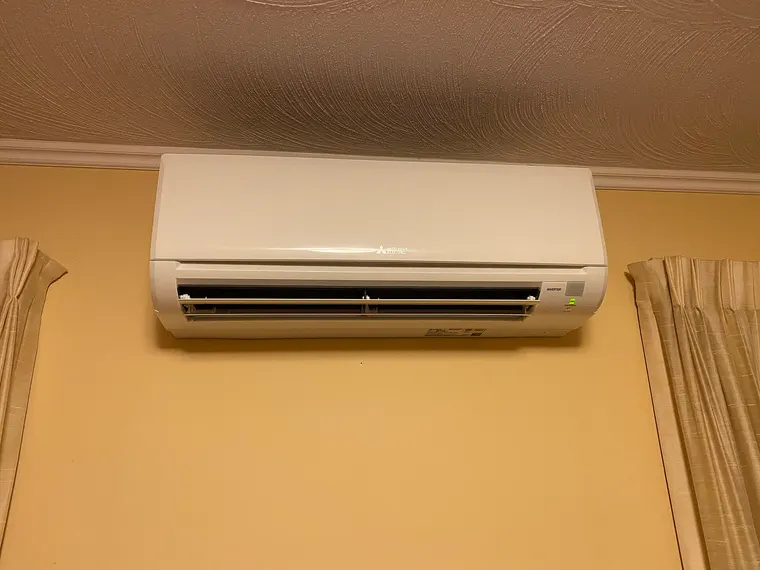
What auxiliary heat actually is
Inside the air handler of most ducted heat pump installations sits a bank of electric resistance elements. They are the same technology as a toaster or an electric baseboard heater: current through a coil, and every watt becomes a watt of heat.
They exist because a heat pump's output falls as it gets colder outside while the house's demand rises. Below the temperature where those two curves cross, called the balance point, the heat pump alone cannot hold the setpoint, and the strips make up the difference.
Auxiliary heat is not the same thing as emergency heat, though thermostats often place the two next to each other. Auxiliary runs alongside the compressor when it needs help. Emergency heat shuts the compressor off entirely and runs on strips alone, and is meant for a failed outdoor unit. If your thermostat is in emergency heat and the outdoor unit is working, turn it off. You are paying triple for no reason.
Three reasons it comes on that are completely normal
1. It is genuinely cold out
Below your balance point the system needs help by design. Federal field measurements found observed switchover temperatures clustering around 30 to 35F. [PNNL-37127 (2025)] If aux appears when it is 25F outside, the system is doing what it was built to do.
2. You raised the thermostat several degrees at once
Most thermostats bring on the strips during recovery, on the reasoning that you want the temperature back quickly. This is why deep night setbacks often cost more than they save in a heat pump house. A heat pump prefers a steady setpoint to the setback and recovery pattern that suits a furnace.
3. The unit is in a defrost cycle
When frost builds on the outdoor coil, the system briefly reverses to melt it, which means it is cooling the house while defrosting. The strips run during those few minutes so you do not get cold air from the vents. A defrost every 30 to 90 minutes in damp cold weather is normal.
When it is telling you something is wrong
- Aux running above roughly 40F. A working, correctly sized system should carry the load alone at that temperature. Something is restricting capacity.
- Aux running for hours at moderate temperatures. Brief appearances during recovery or defrost are expected. Sustained operation is not.
- A blocked filter or an iced outdoor unit. Both reduce the heat pump's capacity, which pushes the balance point up and hands more of the load to the strips. The filter is worth checking before you call anyone.
- Emergency heat left switched on. Easy to do by accident and expensive to leave.
- An undersized or badly commissioned system. The most expensive cause and the hardest to fix after the fact.
What the measurements actually show
Rather than guess how common this is, two Department of Energy funded studies instrumented heat pumps in occupied American homes and measured it.
NREL monitored 12 centrally ducted variable speed heat pumps through a winter. At 5 of the 12 sites, auxiliary heat energy exceeded 35% of compressor heating energy. At 2 sites, the strips consumed more electricity than the compressor did. [NREL/TP-5500-84745 (2023)]
PNNL monitored 22 cold climate units from the DOE Challenge programme, all sized using a Manual J load calculation, and found auxiliary heat to be a small fraction of delivered heat, engaged 25% of the time only in the coldest bin from minus 10 to 0F. [PNNL-37127 (2025)]
What that costs
NREL reports auxiliary as a share of compressor energy. Converting to share of heat delivered, at a COP of 2.5:
| Aux as share of compressor energy | Share of heat from strips | Effective COP | Efficiency lost |
|---|---|---|---|
| 10% | 4% | 2.97 | 8% |
| 20% | 7% | 2.77 | 14% |
| 35% | 12% | 2.53 | 21% |
| 50% | 17% | 2.35 | 27% |
| 100% | 29% | 1.97 | 39% |
The full read of both studies is in the evidence note.
Four households, and what auxiliary heat did to each
Federal studies give you the distribution. Individual households show you what it looks like from the inside, and the four below span nearly the whole range in the dataset.
| Household | Auxiliary heat | Normalised use | What made the difference |
|---|---|---|---|
| Southwest Indiana 2,160 sq ft, 2-ton Daikin |
None used at all | 0.21 | Balance point near 1F, so the strips essentially never engage. R-83 attic, ducts inside the envelope. |
| Boston area 2,750 sq ft, two Bosch IDS |
One night, at −2F, upstairs unit only | 0.75 | Tracked per circuit. The owner believes better attic insulation would remove even that. |
| Ohio 1,863 sq ft, 2.5-ton Carrier |
Carrying essentially the whole load | 1.52 | Breaker for the outdoor unit switched off, plus a wrong sized fuse. Fixing both cut consumption 27%. |
| Southern New Hampshire 1,400 sq ft, $24,000 Samsung |
Roughly half to two thirds of delivered heat | 1.89 | Implied seasonal COP of 1.24 to 1.42 against 2.5 to 3.2 for a working system. |
Watt hours per square foot per heating degree day. Most households sit between 0.53 and 0.83.
The Ohio case is the encouraging one, because it was fixed. Two consecutive months at exactly 3,500 kWh, then 2,565 after a breaker was switched back on and a fuse replaced. Two identical months in a row is itself a clue: a heat pump responding to weather does not repeat a number, and resistance strips holding a setpoint very nearly do.
What backup heat is costing you
The share of heat coming from resistance strips is the input that moves running cost more than any other, and it is the one almost nobody knows. Put in a guess and the arithmetic shows what it is worth finding out.
The combination is harmonic rather than linear, which is why the loss is larger than the share. The arithmetic is worked through here. Nothing you type is sent anywhere.
What to do about it
- Check the filter. Free, takes two minutes, and a blocked filter is a genuinely common cause.
- Check the breaker for the outdoor unit is actually on. On a heat pump it is the same machine that gives you air conditioning, and panels get labelled accordingly. One household in the sources here ran two months at roughly $700 with it switched off.
- Check the outdoor unit is not iced over or blocked. Brief frost during defrost is normal. A solid block of ice is not.
- Confirm you are not in emergency heat. It is the single most expensive setting on the thermostat and it is easy to leave on by accident.
- If you rent and cannot change these settings, the renter page covers what to record and what to ask for.
- Stop using deep setbacks. Try holding a steady temperature for a couple of weeks and compare. Many heat pump houses do better without a setback than with one.
- Ask for the balance point. If your installer ran a load calculation they can tell you the temperature below which aux is expected, and you can check the behaviour against it.
- Consider a combustion backup. If you already have a gas or propane furnace, keeping it as the backup instead of resistance strips removes the COP 1.0 penalty entirely. That is a dual fuel system.
Common questions
Is it bad if my heat pump uses auxiliary heat?
Not by itself. Some auxiliary use below the balance point is designed behaviour. It becomes a problem when it runs at mild temperatures, runs for sustained periods, or accounts for a large share of your heating energy.
At what temperature should auxiliary heat come on?
It depends on the pairing of equipment and house, not on the equipment alone. Federal field measurements found observed switchover temperatures clustering around 30 to 35F. Auxiliary heat appearing above roughly 40F suggests something is limiting capacity.
How much does auxiliary heat cost?
Electric resistance heat runs at a COP of exactly 1.0 against roughly 2.6 for the heat pump, so it costs about 2.6 times as much per unit of heat. If a quarter of your heat comes from the strips, you lose roughly a third of your seasonal efficiency.
Can auxiliary heat run without the heat pump running at all?
Yes, and it is more common than it should be. If the compressor is locked out by a thermostat setting, switched off at the breaker, or limited by a failed component, the strips will hold your setpoint on their own and nothing will report a fault. One household in the sources here ran two full months that way. The lockout page has a calculator that tests for it.
What is the difference between auxiliary heat and emergency heat?
Auxiliary heat supplements the compressor when it needs help. Emergency heat shuts the compressor off and runs on resistance strips alone, and is intended for a failed outdoor unit. Emergency heat left on by accident is expensive.
Does turning down the thermostat at night save money with a heat pump?
Often less than you would expect, and sometimes not at all. Many thermostats bring on resistance strips during recovery, which can cost more than the setback saved. A steady setpoint frequently works out cheaper in a heat pump house.
How this was checked
The measured figures on this page come from two reports I read directly rather than from secondary coverage: NREL/TP-5500-84745 and PNNL-37127, both funded by the Department of Energy and both public.
The conversion from auxiliary share of energy to auxiliary share of delivered heat is mine, since the studies report the first and this site models the second. The formula is shown on this page and derived in full in the evidence note, so you can check it rather than take it.
What this page does not cover
This page cannot diagnose your specific system. It gives you the normal patterns, the abnormal ones, and the questions that get a useful answer out of a contractor. It does not cover refrigerant charge, reversing valve faults, or control wiring, all of which need someone with instruments in front of the equipment.
References
- Winkler, J. and Ramaraj, S. (2023). Field Validation of Air-Source Heat Pumps for Cold Climates. NREL/TP-5500-84745. National Renewable Energy Laboratory. May 2023.
- Mendon, V., Keene, K., Rosenberg, S., Rotondo, J. A., Nwe, K., Young, J., Wind, W., and Goetzler, B. (2025). Performance Results from DOE Cold Climate Heat Pump Challenge Field Validation. PNNL-37127. Pacific Northwest National Laboratory, prepared for the U.S. Department of Energy under Contract DE-AC05-76RL01830. January 2025.
- Homeowner report and follow-up, r/hvacadvice. Ohio, 1,863 sq ft all electric new build ranch, 2.5-ton Carrier heat pump. Includes the owner's own update recording what the fault turned out to be.
- Homeowner report and follow-up discussion, r/heatpumps, January 2026. Southwest Indiana, 2,160 sq ft bi-level, 2-ton Daikin Fit ducted air source heat pump. Figures for design load, capacity, balance point, insulation levels and metered usage are the homeowner's own, given across the thread.
- U.S. Department of Energy, Heat Pump Database, field study repository.
- Air Conditioning Contractors of America. Manual J: Residential Load Calculation, the standard method for sizing residential heating and cooling equipment.
- U.S. Department of Energy, Office of Energy Efficiency and Renewable Energy. Heat Pump Systems.
Related reading
See what backup heat costs you
The calculator takes backup share as an input. Try 10%, then 25%.
Open the calculator