Dual fuel vs a heat pump alone: what the numbers actually point to
The short version
- A dual fuel system pairs a heat pump with a combustion furnace and switches between them at a set outdoor temperature, called the crossover or switchover point.
- It exists to solve the single largest problem in heat pump running cost: electric resistance backup heat, which runs at COP 1.0 and can cost you 27% of your seasonal efficiency at only 15% of heat delivered.
- In the 33 states where gas currently beats a heat pump outright, dual fuel captures the heat pump's advantage in mild weather without paying its penalty in cold weather.
- The crossover temperature should be set from the economics, not from a default. The correct point is where the falling COP makes the heat pump cost the same per unit of heat as the furnace.
In the 33 states where a gas furnace beats a heat pump on running cost, the arithmetic is not arguing for keeping the furnace. It is arguing for running both and switching between them at the right temperature.

What a dual fuel system is
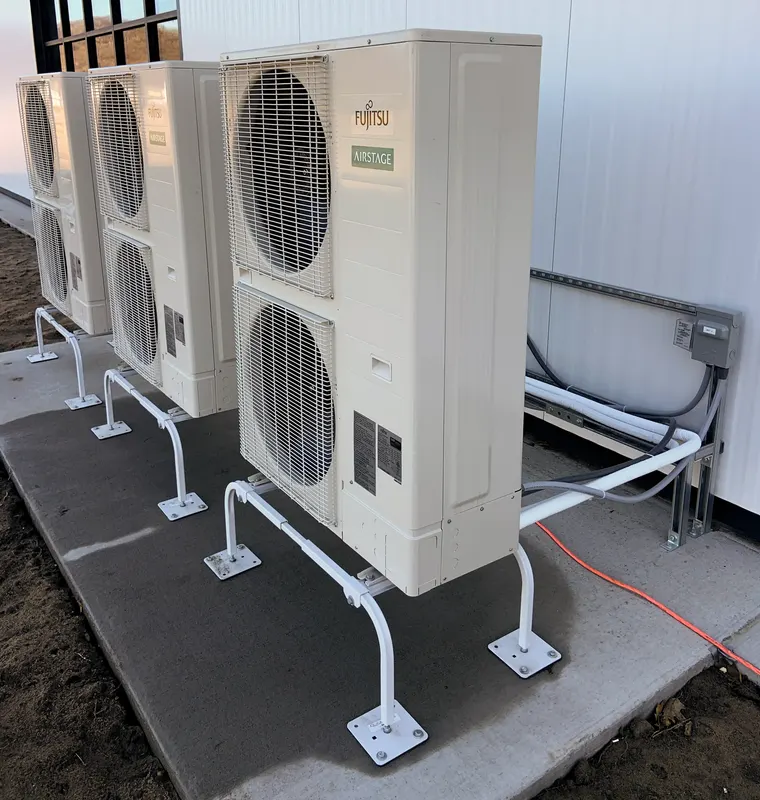
A dual fuel system, sometimes called a hybrid system, is a heat pump and a combustion furnace sharing the same ductwork and the same thermostat. Only one runs at a time. A control decides which, based on outdoor temperature.
Above the crossover temperature the heat pump does all the heating. Below it, the heat pump shuts off and the furnace takes over completely. There is no blending, and critically, there are no electric resistance strips in the picture at all. The furnace is the backup.
Physically it is not exotic. A heat pump outdoor unit replaces the air conditioner, the existing furnace stays where it is and becomes the backup heat source, and the thermostat is replaced with one that understands two heat sources.
Why it exists: the backup heat problem
A heat pump alone in a cold climate has a structural weakness. As outdoor temperature falls, two things happen at once. The house needs more heat, and the heat pump gets worse at supplying it, because there is less heat in the outdoor air and a larger temperature difference to work across.
Below the balance point, output no longer meets demand, and the shortfall has to come from somewhere. In a standard installation that somewhere is a bank of electric resistance strips running at a COP of exactly 1.0.
Dual fuel removes that failure mode. On the coldest nights the furnace runs instead of the strips, and the furnace at 95% AFUE on cheap gas is far cheaper per unit of heat than resistance heat on expensive electricity.
Setting the crossover temperature
This is the decision that determines whether a dual fuel system saves money or wastes it, and it is routinely set to a default and never revisited.
The correct crossover is where the two machines cost the same per unit of delivered heat. Above it the heat pump is cheaper and should run. Below it the furnace is cheaper and should run.
Because heat pump COP falls with outdoor temperature while the furnace's AFUE stays flat, there is a temperature at which the two lines cross. Setting the crossover above that point burns gas when the heat pump was still cheaper. Setting it below burns expensive electricity when the furnace was cheaper.
What moves the crossover
- Your price ratio. The higher your electricity price relative to gas, the warmer the crossover should be, because the heat pump stops being cheaper sooner.
- The heat pump's cold weather performance curve. A unit that holds COP well at low temperature earns a colder crossover. This is not visible in the HSPF2 rating, which is a season average. Ask for the capacity and COP tables at 47F, 17F, and 5F.
- Your furnace's AFUE. A less efficient furnace pushes the crossover colder, because the furnace is a weaker competitor.
Your state's current price ratio is on your state page, and the equipment side of the threshold is on the calculator. If you set these for other people rather than for your own house, the same material is laid out for that conversation.
The breakeven COP for every state against all three fuels is set out here, along with how to read your own crossover off the unit's data sheet in about ten minutes.
A worked case: told 20F by one person and 30F by another
A New England household with a five zone Mitsubishi Hyper Heat 2i and a furnace for backup opened a $700 December bill and went looking for the right crossover setting. The salesperson had told them to switch to the furnace at 20F. The installer had told them 30F. Neither gave a reason, and the ten degrees between those two answers is a lot of winter. [r/heatpumps, crossover advice]
The question as posed cannot be answered, and the reason is worth more than the answer would have been. Nobody asked what the furnace burns. A crossover temperature is not a property of the heat pump. It is the temperature at which the heat pump's falling COP meets the number set by your two prices, and that number moves by a factor of two depending on whether the other machine burns gas, propane or oil.
Here is that number for every New England state this site has complete data for, at each state's own heating season prices. It is the coefficient of performance the heat pump has to beat. Above it the heat pump is cheaper, below it the furnace is.
| State | Electricity | vs gas, 95% | vs oil, 83% | vs propane, 95% |
|---|---|---|---|---|
| Connecticut | 0.281 | 4.72 | 2.50 | 2.01 |
| Maine | 0.311 | no data | 2.77 | 2.22 |
| Massachusetts | 0.308 | 3.44 | 2.74 | 2.20 |
| New Hampshire | 0.264 | 4.00 | 2.35 | 1.88 |
| Rhode Island | 0.302 | 4.18 | 2.69 | 2.16 |
| Vermont | 0.233 | 4.14 | 2.07 | 1.66 |
Maine has no gas column above, because EIA has not published a complete December to February residential gas season for it. Its oil and propane figures are real, which is the point: an earlier version of this site dropped Maine from the dataset entirely for want of a gas price, in a state that heats overwhelmingly with oil. Maine has its own page now, and so do the other five. The rule is that a missing fuel removes a column, not a state.
What that table says to the household in question
- If the furnace burns gas, the heat pump has to return a COP between 3.4 and 4.7 just to break even. No cold climate heat pump on the market does that below roughly 40F, and most do not do it at any temperature. Both 20F and 30F are too cold. On running cost alone the furnace should be doing nearly all of the winter, and a $700 December is the predictable result of it not doing so.
- If the furnace burns propane, the target drops to between 1.7 and 2.2, which a Hyper Heat holds well into the teens. Now both answers are far too warm, and switching at 30F means burning propane for weeks while the heat pump was still the cheaper machine.
- If it burns oil, the target sits between 2.1 and 2.8 and the honest answer lands somewhere near the two numbers they were given, which is the only case where either piece of advice was accidentally reasonable.
How to find yours in about ten minutes
- Take the target COP for your state and fuel from the table above, or from your own two prices if you have a bill in front of you. Your state page has both figures.
- Get the COP table for your outdoor unit. It is in the submittal or the engineering data sheet, not the brochure, and it lists capacity and input power at 47F, 17F and 5F. COP is capacity in BTU/h divided by input watts, divided by 3.412. [AHRI 210/240-2023]
- Read off the temperature where your unit's COP crosses the target. That is your crossover. Interpolating between the published points is close enough for a thermostat setting.
- Then move it warmer if the fuel price is volatile. Propane and oil prices move a lot within a single winter, electricity much less, so a crossover set on a summer propane price will be wrong by January.
This will not match what your installer set, and it is worth checking which of you is closer before assuming it is you. The most common failure in these systems is a crossover left at a factory default that has no relationship to what anybody pays for anything.
Where dual fuel makes the most difference
The states where a heat pump loses to gas outright are exactly the states where dual fuel has the most to offer, because the gap it closes is largest there.
| State | Price ratio | Heat pump alone vs gas | What dual fuel offers |
|---|---|---|---|
| Alaska | 6.01 | 117% more | Heat pump in mild weather, furnace below crossover |
| Michigan | 5.72 | 106% more | Heat pump in mild weather, furnace below crossover |
| New York | 5.37 | 94% more | Heat pump in mild weather, furnace below crossover |
| Idaho | 5.37 | 93% more | Heat pump in mild weather, furnace below crossover |
| Illinois | 5.10 | 84% more | Heat pump in mild weather, furnace below crossover |
It is worth being clear about what dual fuel does and does not do in these states. It does not make the heat pump cheaper than the furnace on the coldest nights. It stops you from paying resistance heat prices on those nights, and it lets you capture the heat pump's genuine advantage during the much larger number of mild hours that make up most of a heating season.
The honest trade-offs
Dual fuel is not free and it is not always right.
- You are maintaining two heating systems. Two sets of service, two failure modes, and a gas connection you keep paying a fixed monthly charge on whether you burn much or not.
- Capital cost is higher than a heat pump alone if you would otherwise have removed the furnace, though it is usually lower than a full furnace replacement plus a new air conditioner.
- It keeps you on a combustion appliance. If your reason for switching is emissions rather than running cost, dual fuel is a compromise and should be evaluated as one.
- The control has to be set correctly. A dual fuel system with a badly chosen crossover can cost more than either machine alone. This is the most common way these systems disappoint.
Common questions
What is a dual fuel heat pump system?
A heat pump and a combustion furnace sharing ductwork and a thermostat, with a control that switches between them at a set outdoor temperature. The heat pump handles mild weather, the furnace handles cold weather, and electric resistance backup is not used.
What should the crossover temperature be set to?
The temperature at which the two systems cost the same per unit of delivered heat. That depends on your electricity to gas price ratio, your heat pump's COP at low temperature, and your furnace's AFUE. There is no single correct number, and a default set at installation is unlikely to be right for your rates.
Is dual fuel cheaper than a heat pump alone?
In states where gas is cheap relative to electricity, usually yes, because it avoids electric resistance backup at COP 1.0 on the coldest nights. In states where the heat pump already beats gas outright, the benefit is smaller and mostly limited to extreme cold.
Can I keep my existing furnace and add a heat pump?
That is the normal way a dual fuel system is created, and it is why the retrofit is often cheaper than people expect. The heat pump outdoor unit takes the place of the air conditioner, the furnace stays, and the thermostat is replaced.
Does dual fuel work with propane or oil?
Yes, and it is often more valuable there, because avoiding resistance backup matters regardless of which fuel the backup burns. The economics differ because propane and heating oil are more expensive per unit of heat, which pushes the crossover colder.
How this was checked
Fuel prices are pulled from the EIA public API and averaged over the most recent complete December to February window, using identical months for every state. Summer months are excluded deliberately. EIA's residential price is total revenue divided by total volume, and in summer the fixed monthly customer charge is divided by almost no gas, which inflates the apparent price by up to 114%. That error is documented in the corrections log.
The same rate file drives the calculator, every state page, and every table on this page, so the tool and the writing cannot disagree. Unit conversions were derived twice, once in dollars per unit of chemical energy and once in dollars per delivered BTU, and both give the same threshold.
No verdict is declared inside a 10% margin, because more than a third of season-to-season price moves are larger than that.
What this page does not cover
This page does not model your specific crossover temperature, because doing that honestly requires your heat pump's capacity and COP tables at several outdoor temperatures plus a heat loss calculation for your house. Neither is available from a state level dataset.
It also does not cover installation cost, control compatibility between specific equipment brands, or the gas standing charge you continue paying to keep the connection.
References
- U.S. Energy Information Administration, Electricity Data Browser, residential retail price by state.
- U.S. Energy Information Administration, Natural Gas Prices, residential price by state.
- AHRI Standard 210/240-2023, Performance Rating of Unitary Air-Conditioning and Air-Source Heat Pump Equipment.
- Homeowner report, r/heatpumps. New England, five zone Mitsubishi Hyper Heat 2i on a dual fuel setup with a $700 December bill. The salesperson told the owner to switch to the furnace at 20F and the installer told them 30F, and neither gave a reason.
Related reading
Find your crossover starting point
The calculator gives you the price ratio and equipment threshold that set where the crossover belongs.
Open the calculator